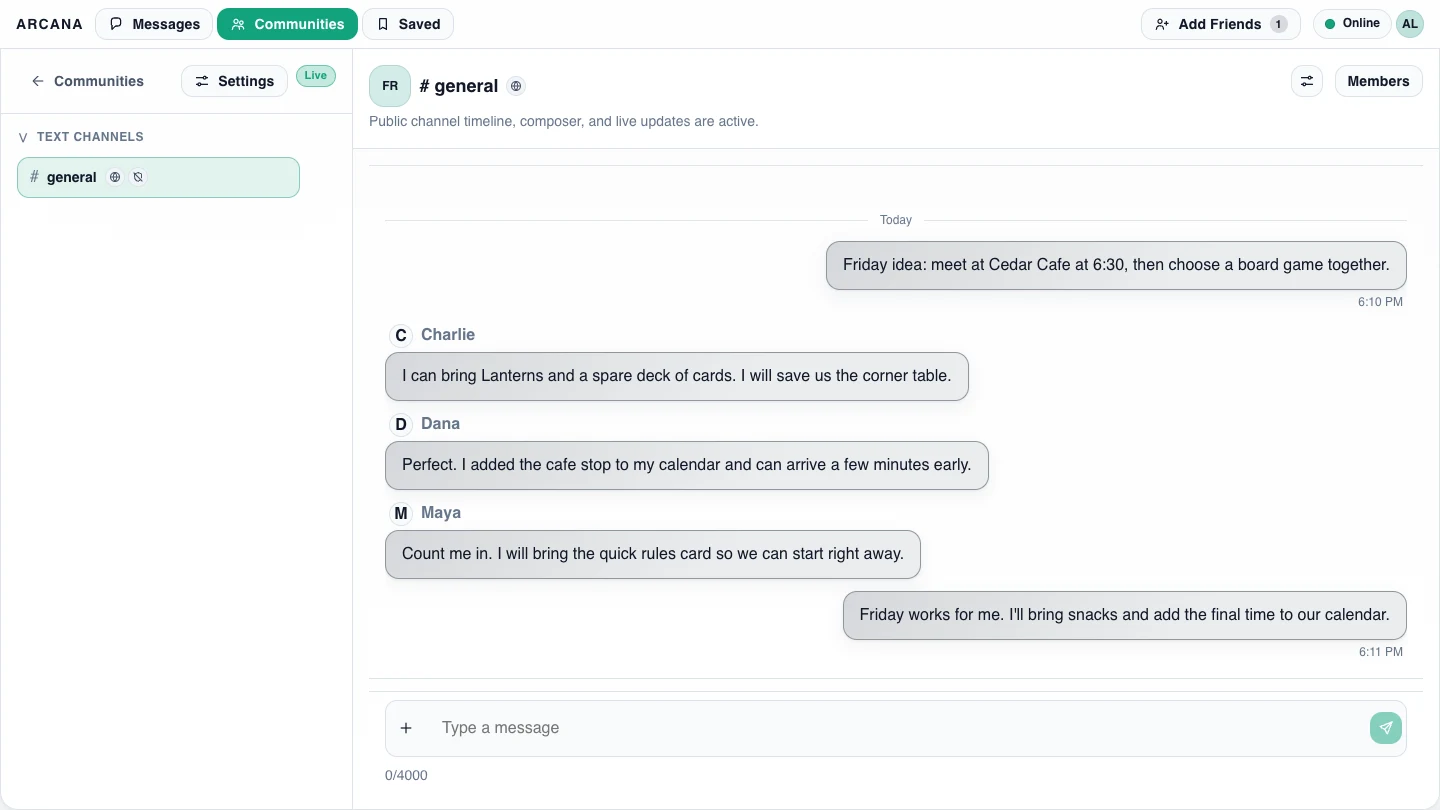
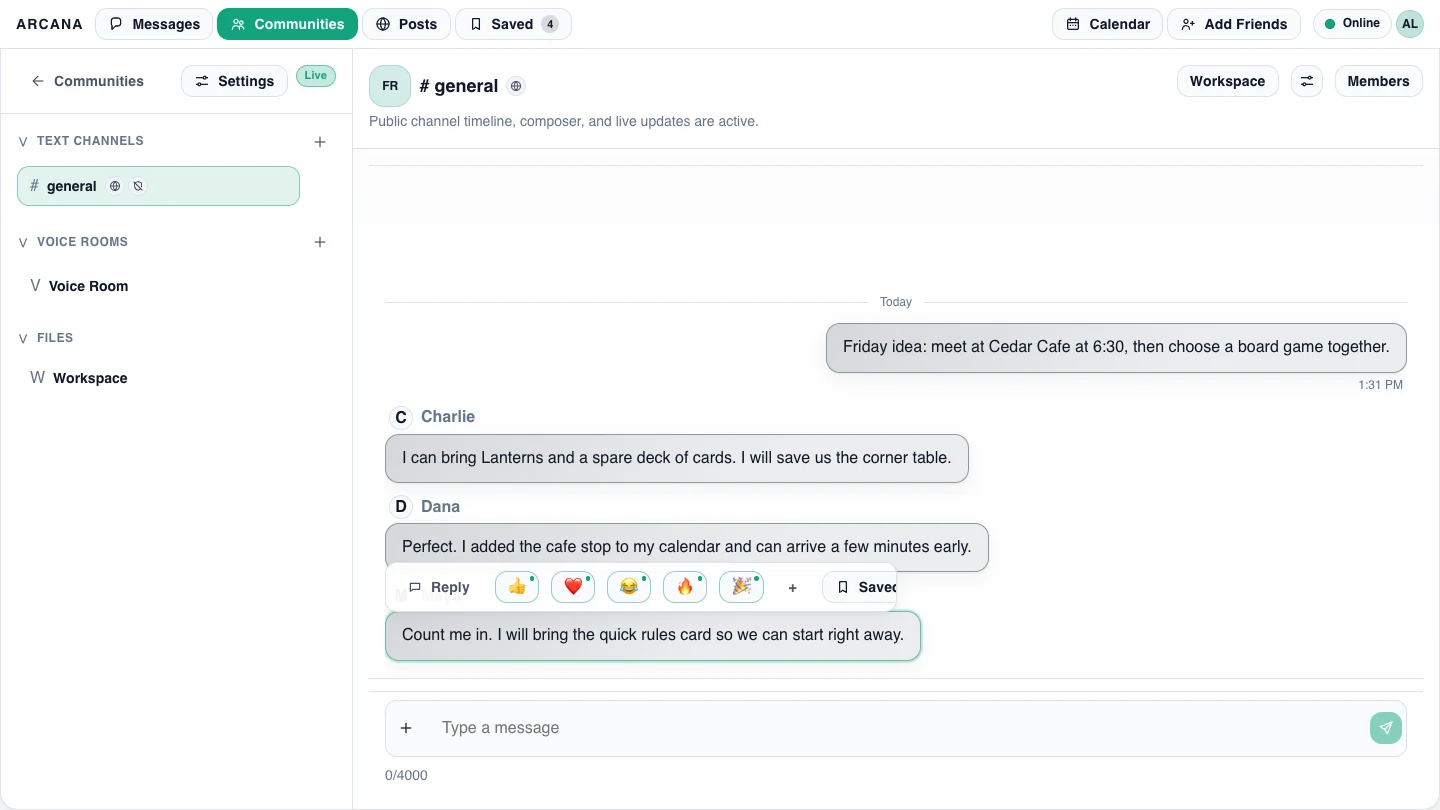
Arcana's interface sits over a larger engineering system: cloud hosting, encrypted messaging, realtime voice and shared tools all depend on the same identity, device and permission boundaries.
The implementation combines a shared client, a modular backend and explicit security contracts. The result is one platform for private communication and collaborative work, not a collection of disconnected features.
A social platform can look unified while hiding very different requirements for authority, persistence, encryption and realtime delivery. Arcana's architecture makes those differences explicit instead of forcing every feature through one generic subsystem.
01
Cloud systems still need clear boundaries.
Application services, data, media and operations have different reliability and access requirements. The hosting model keeps those concerns separated without exposing infrastructure decisions through the product surface.
02
Privacy changes by surface.
A private message, attachment, voice call and shared Workspace object do not have the same readability requirements. Encryption, permissions and collaboration behaviour are designed for the context instead of reduced to one blanket claim.
03
Realtime media cannot bypass authority.
Call admission, room membership, device trust and revocation remain authorized even when media travels through dedicated realtime infrastructure. Reconnect and access changes need predictable failure behaviour.
04
Shared tools multiply state models.
Boards, pages, saved collections, filters, variables and editors all need collaboration, permissions and history. They reuse a Workspace substrate instead of inventing isolated identity, storage and access systems.
The system architecture
Modular at the seams. Cohesive at the core.
Arcana uses a modular platform model: identity, messaging, policy and audit stay shared while collaborative capabilities retain clear ownership and access boundaries.
Platform architecture
A deliberately simplified public view of the system's major responsibilities.
Shared identity and policyExplicit feature ownershipReplaceable service boundaries
Technical pillars
The systems behind the product.
01
Managed cloud foundation
Arcana uses an AWS-based hosting environment with separated application, data, media and operational concerns. The case study intentionally keeps the deployment topology and operating procedures private.
02
End-to-end encryption
Private messaging is designed around client-side encryption and device-aware access. Transport security, stored-data protection and E2EE remain distinct boundaries rather than interchangeable marketing labels.
03
Realtime voice calls
Call permissions and room state are separated from dedicated media routing. That keeps realtime communication responsive while preserving a clear trust boundary around private media.
04
Permission-aware filters
Workspace and channel search narrow results through the same access rules as the underlying content. Filters and saved views improve retrieval without becoming a separate source of authority.
05
Shared Workspace
Pages, boards, planning, publishing, saved collections, permissions and activity reuse one Workspace substrate. Specialized surfaces consume shared contracts instead of building parallel collaboration silos.
06
Reusable tooling
Shared feature contracts, interface patterns and typed data models let Arcana add collaborative tools without creating a new identity, permission and activity system for each one.
A protected request path
One action. Four protected layers.
A private action moves through a small set of protected layers. Each layer owns one responsibility while implementation-specific services and internal controls remain outside this public view.
Example pathProtected message sendDeliberately simplified
01Client
Protect content
Validate the action and prepare private content before it crosses the application boundary.
02Policy
Check authority
Reconfirm the account, device, membership and feature permissions for the request.
03Platform
Apply rules
Keep messaging and security behaviour inside owned platform contracts.
04Cloud services
Store and deliver
Persist protected content, notify authorized recipients and record safe operational signals.
Permission checks at every boundaryPrivate-message content stays protectedOperational signals exclude private content
Security architecture
Security is a matrix, not a badge.
Arcana separates encrypted transport, managed at-rest protection and content-level end-to-end encryption. Private messages and encrypted attachments use a client-side protection boundary; shared and moderated surfaces remain readable where their functions require it.
Device trust is treated separately from account login so access to an account does not automatically imply access to every encrypted history. The public case study intentionally omits key formats, migration mechanics and internal recovery procedures.
Private communication
Client-side protection
Private-message and attachment content is protected before storage or delivery, with access scoped to approved devices.
Current product boundaryShared product surfaces
Context-aware privacy
Workspace, community and moderation tools use explicit access policy when collaboration requires server-readable information.
Calls that keep media outside the server trust boundary.
Arcana separates call authority from media transport. The platform can decide who may join and which device is active while dedicated realtime infrastructure handles the media path.
Call control
Room authority
Session, membership, device trust, room state and access changes are checked by the platform.
Policy boundary
→
Realtime media
Dedicated routing
Purpose-built media services handle low-latency audio without taking over application permissions.
Separate media boundary
→
Client experience
Local controls
Mute, device preferences and optional voice effects remain close to the participant experience.
Privacy-aware defaults
Access changes
Membership, trust and room-state changes are reflected before protected participation continues.
Voice filters
Optional spatial and effect processing stays client-local, with a normal-audio fallback.
Failure mode
Unavailable privacy or authority requirements close the protected path instead of silently weakening it.
Architecture shown at a deliberately high level · Provider topology and security mechanics remain private
The technical result
Built to expand without splitting the system.
The architecture keeps Arcana deployable as one application while giving cloud services, crypto, calls and collaborative tools explicit boundaries. New capabilities reuse identity, permissions, audit and interface composition without reaching directly across every domain.
Managed AWS hosting with separated service concerns
Modular platform and shared client architecture
Explicit transport, storage and E2EE boundaries
Authority-aware realtime voice architecture
Permission-aware search, filters and saved views
Shared Workspace substrate for boards, pages and tools
This case study communicates architectural principles, not Arcana's deployment topology, security implementation or operating procedures.
Application engineering
Need software engineered beyond the interface?
Sphere designs the product surface and the systems behind it: domain architecture, security boundaries, realtime behaviour, infrastructure adapters and cross-platform delivery.